Tannaz Karimi, Researcher in International Relations; Migration, and Refugee Studies
Are today’s migration waves driven solely by poverty, war, and the lack of opportunities, or do social media, digital narratives, and geopolitical competition also shape them?
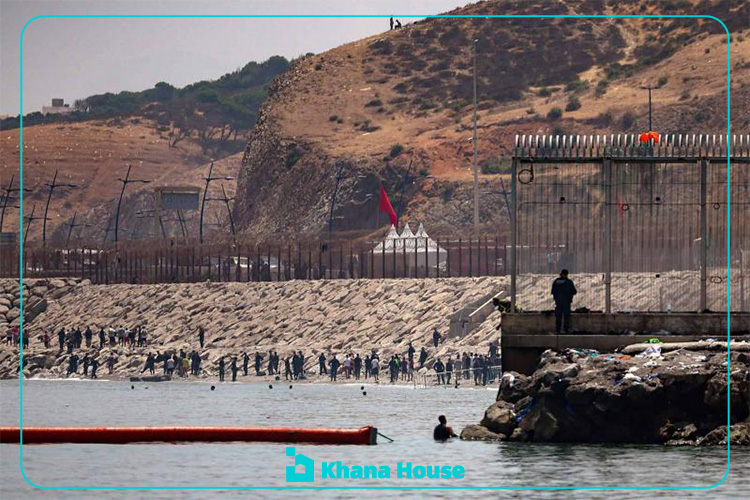
Recent migration crises suggest that economic and political factors alone are no longer sufficient to explain large-scale population movements. Social media can rapidly influence migration decisions, while border policies have increasingly become instruments of interstate bargaining. The recent crisis in Ceuta, Spain’s autonomous city in North Africa, illustrates the intersection of these three dimensions: structural drivers of migration, digital narratives that shape migration dynamics, and geopolitical competition that turns border management into a tool of foreign policy.
Layer One: Why Do People Consider Migration?
No migration wave emerges without underlying economic, social, and political conditions. The push–pull theory of migration suggests that factors such as poverty, unemployment, and inequality push individuals to leave their country of origin while the prospect of better opportunities elsewhere attracts them to destination countries. Likewise, Douglas Massey and his colleagues argue that migration results from the interaction of economic conditions, structural inequalities, and social networks (Massey et al., 1993).
Morocco represents one of the principal migration routes to Europe due to high youth unemployment, the significant economic gap with Europe, and its geographical proximity to Spain. Nevertheless, these factors alone cannot explain why thousands of people decide to move simultaneously at a particular moment.
Layer Two: Social Media and the Formation of Migration Waves
Today, social media plays a significant role in migration decision-making. Dekker and Engbersen (2014) argue that digital platforms have facilitated access to migration-related information and personal experiences, while simultaneously creating fertile ground for the spread of rumors and misleading narratives.
During the recent Ceuta crisis, the widespread circulation of reports suggesting that crossing into Spain had become easier altered many young Moroccans’ perception of migration opportunities and contributed to the sudden movement toward the border. Social media does not merely disseminate information; it also shapes individuals’ expectations and their assessment of opportunities and risks.
Layer Three: The Geopolitics of Migration: When Borders Become Instruments of Power
If structural factors create the motivation to migrate and social media shapes the timing and dynamics of movement, the third layer concerns the role of states and foreign policy in managing migration flows. In recent years, migration has evolved beyond a humanitarian issue and has increasingly become part of geopolitical competition.
In Weapons of Mass Migration (2010), Kelly M. Greenhill argues that under certain circumstances, states can use migration flows to impose political, economic, or security costs on other countries. She describes this phenomenon as “engineered migration.” However, Greenhill also emphasizes that not every migration wave is the result of deliberate state planning. A distinction must therefore be made between intentionally creating a migration crisis and politically exploiting an existing one.
This theoretical framework is particularly relevant to Morocco–Spain relations. Over the past decade, the European Union has increasingly externalized border control by relying on neighboring countries—including Morocco, Tunisia, Libya, and Turkey—to manage migration before it reaches European territory. Owing to its proximity to the Spanish autonomous cities of Ceuta and Melilla, Morocco has become one of the EU’s most important security partners in migration management. Consequently, any change in Morocco’s level of cooperation has direct implications for the security of Europe’s external borders.
It is important to note that Ceuta is not merely a border between Morocco and Spain; it is also one of the European Union’s external frontiers. As a result, developments in Ceuta extend beyond bilateral relations and influence the EU’s broader migration and border security policies.
Three main explanations have been proposed for the recent crisis: persistent economic and social pressures in Morocco, the widespread circulation of reports suggesting easier access to Spain, and the possibility that Moroccan border controls had been relaxed. While all three factors likely contributed to the crisis, some analysts argue that neither economic hardship nor online rumors alone can fully explain the scale and speed of the migration wave.
In this context, the issue of Western Sahara is particularly significant. Only days before the crisis, Spanish Prime Minister Pedro Sánchez visited Algeria to discuss energy cooperation and bilateral relations. According to some analysts, what concerned Rabat was Sánchez’s failure to explicitly reaffirm Spain’s support for Morocco’s autonomy proposal for Western Sahara. This was interpreted by some observers as a possible sign of Madrid’s shifting position and growing rapprochement with Algeria.
This interpretation is reinforced by the memory of the 2021 Ceuta crisis. After Spain admitted Brahim Ghali, the leader of the Polisario Front, for medical treatment, thousands of migrants crossed into Ceuta within a short period. Many analysts viewed that episode as an example of the political use of border management. The crisis gradually subsided after Spain later endorsed Morocco’s autonomy initiative for Western Sahara. Consequently, some observers have suggested that the recent reduction in border enforcement may likewise have served as a form of coercive diplomacy aimed at increasing political pressure on Madrid, although no direct evidence has confirmed this claim.
At the same time, the crisis should also be understood within the broader regional context. Following the Iran–U.S.–Israel war, disagreements emerged between Spain and several of its Western allies over regional issues, particularly the war in Gaza. Sánchez’s visit to Algeria—Morocco’s principal regional rival—further heightened political sensitivities. While these developments do not demonstrate that the border crisis resulted from coordinated geopolitical action, they do illustrate the extent to which border management has become intertwined with broader strategic rivalries.
Under such circumstances, migrants and asylum seekers bear the greatest costs of geopolitical competition. When border management becomes an instrument of political bargaining, the lives and futures of thousands of people are shaped by decisions made at the level of international politics. Migration, therefore, is no longer simply an individual pursuit of a better life; in certain contexts, it becomes a variable in broader power politics, with the movement of people influenced by the strategic calculations of states.
Conclusion
The Ceuta crisis shows that migration is shaped not only by structural factors such as poverty and unemployment, but also by social media and geopolitical dynamics. The widespread circulation of reports about easier access to Spain helped trigger the recent migration wave, while questions over border management highlight how migration can become intertwined with interstate politics. As one of the European Union’s external frontiers, Ceuta illustrates the growing link between migration, security, and foreign policy.