By Mohammadreza Mohammadi, International Affairs Researcher
In the complex chessboard of Middle Eastern geopolitics, perception often shapes policy more than reality itself. When decision-makers rely on distorted mental images instead of facts on the ground, strategy can become trapped in illusion rather than guided by insight.
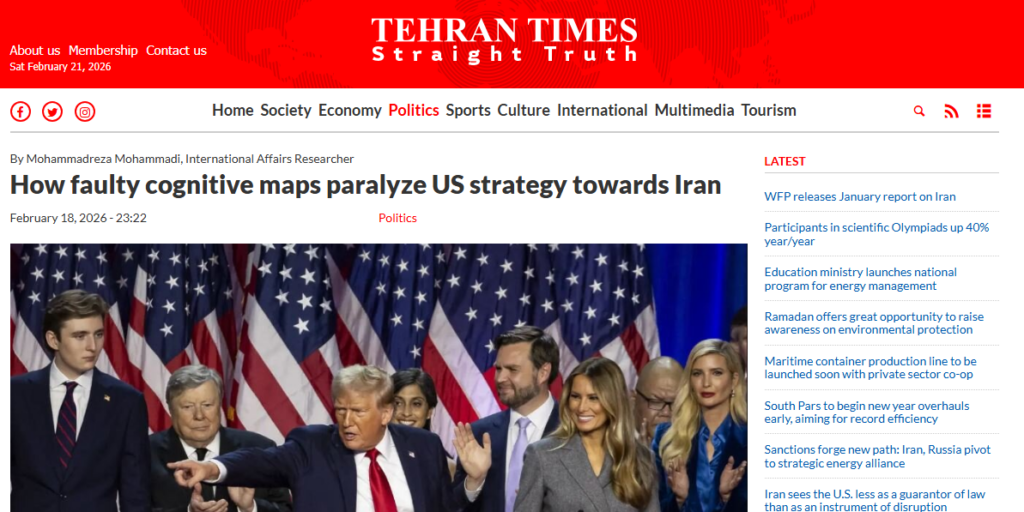
In “How Faulty Cognitive Maps Paralyze US Strategy Towards Iran,” Mohammadreza Mohammadi, an international affairs researcher, argues that U.S. policymakers’ entrenched misperceptions about Iran have severely hampered Washington’s ability to craft an effective strategy. Mohammadi contends that American decision-makers rely on outdated mental models that depict Iran as weak, internally unstable, and ripe for collapse, despite recent events such as Iran’s resilient performance in the 12-day conflict challenging these assumptions. He says these “faulty cognitive maps” lead U.S. officials to discount contradictory evidence, misinterpret Iranian domestic cohesion, and overvalue external narratives, especially those promoted by Israel, which cast Iran as an existential threat. As a result, the United States oscillates between pressure and negotiation without a clear strategy. Mohammadi concludes that only by correcting these cognitive distortions and grounding policy in objective realities can the U.S. develop predictable, sustainable engagement with Tehran.
Read more on Tehran Times Website