
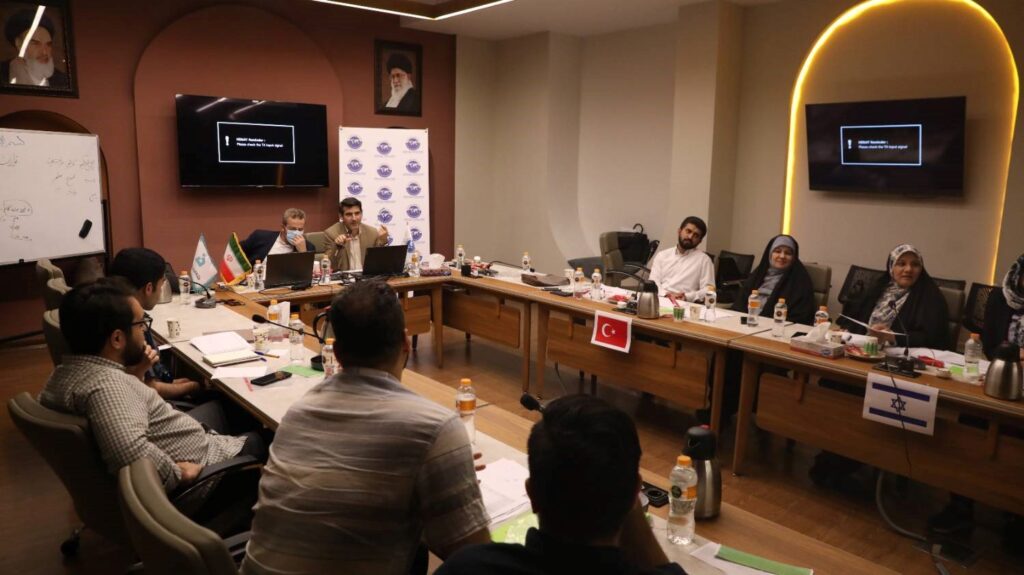
A review of the simulation game “Balance in Fire: Middle East Conflict Simulation”, held in early June at KHANA, brought together professors of international relations, diplomacy, and political studies. Organized by the Institute for Contemporary World Studies and designed by Dr. Shoaib Bahman, the simulation was structured as an interactive model based on game theory.
Objectives and Structure of the Simulation
The project’s main objective was to recreate conflict-driven scenarios involving key actors such as Iran, Saudi Arabia, Israel, the U.S., Russia, China, Turkey, and non-state groups (e.g., Hezbollah, Hamas, and ISIS). In this context, tools like diplomacy, threats, alliances, espionage, and strategic competition were not just theoretical concepts but practical mechanisms of action in real-world situations.
Game Mechanics: From Theory to Practice
The game design was rooted in each country’s geopolitical interests and implemented using score and scenario cards, enabling strategic dialogues among participants and allowing in-depth cost-benefit analysis of political decisions. It provided a hands-on platform for participants to engage as actors—not merely analysts—in dissecting complex geopolitical dynamics.
Educational Workshops: Bridging Theory and Practice
Alongside the simulation, a series of specialized educational workshops were held where distinguished scholars delved into both theoretical and practical layers of international politics:
Geopolitical Shifts and Regional Realities
Dr. Ahmad Dastmalchian examined the impact of the Arab Spring, AI-driven cognitive warfare, and the tension between tradition and modernity in shaping Saudi Arabia’s political structure and the emerging regional order.
Dr. Dariush Safarnezhad and Mohammad Keshavarzzadeh provided an in-depth analysis of China’s power and economy and reinterpreted the dynamics among the U.S., Russia, and Iran, offering new perspectives on smart governance and geopolitical rivalries.
National Identity and Strategic Culture
Dr. Asadollah Athari focused on Turkey’s identity crisis and internal developments around the PKK, discussing the evolving political landscape in Ankara.
Dr. Alireza Miryousefi explored U.S. policymaking mechanisms, including the roles of think tanks, media, and electoral systems in shaping American strategic interests.
Strategic Mindsets in International Relations
Dr. Reza Rezaei, in the workshop on “rules of the game,” introduced concepts such as strategic deception, consensus-building, and bluffing in international relations, offering a theoretical entry point into the simulation.
Conclusions and Educational Impact
Despite time constraints, the exercise was met with strong participant engagement. Comprehensive documentation—including class materials, group decisions, and final interviews—will support future qualitative analyses.
In this light, “Balance in Fire” emerges not just as an educational tool but as a new model for teaching politics in contemporary Iran—one that bridges the gap between theoretical analysis and lived political experience.


