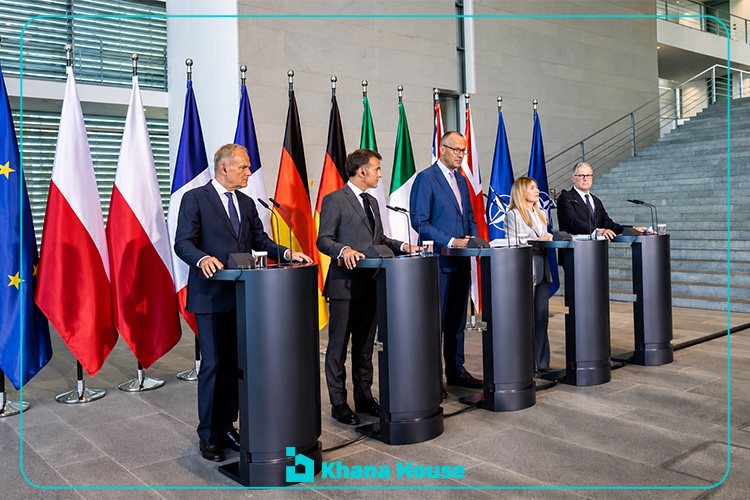
Europe’s post-Ukraine security environment and growing uncertainty over the durability of U.S. defense commitments have accelerated the restructuring of Western security arrangements. Against this backdrop, the E5—comprising France, the UK, Germany, Italy, and Poland—has emerged as a more agile security core capable of addressing issues beyond the bureaucratic frameworks of the EU and NATO. Its expanding focus on West Asian security signals a shift in Europe’s threat perceptions toward Iran, highlighting the need for Tehran to reassess its diplomatic and defense strategies.
1. Structural Transformation in Europe’s Security Architecture and the Rise of the E5
Europe’s major powers have increasingly sought more agile security mechanisms beyond the decision-making constraints of the EU and NATO. The E5—France, the UK, Germany, Italy, and Poland—has evolved from an informal coordination platform into a potential core of European defense cooperation, particularly amid uncertainty over U.S. security commitments.
2. Three Drivers Behind the Formation of the E5
Political-Security Driver
The E5 aims to enable faster crisis response and strategic coordination without being constrained by the EU’s 27-member consensus-based decision-making process.
Military and Industrial Driver
The war in Eastern Europe exposed major weaknesses in Europe’s ammunition stocks, defense-industrial capacity, and supply chains. The E5 seeks to strengthen Europe’s military-industrial foundations and operational self-reliance.
Geopolitical Driver
Europe’s perception of Russia as a long-term security threat has increasingly converged with concerns over instability in the Middle East and the security of international transport routes.
- Expansion of Europe’s security horizon beyond its eastern borders
- Greater attention to the Middle East and West Asia
- Recognition that regional conflicts can directly affect European security and economic stability.
3. Europe’s Changing Strategic Perception of Iran
Europe is increasingly viewing Iran as a broader security challenge rather than solely a diplomatic or nuclear issue.
- Greater European cohesion: The E5 could reduce divisions among European states in dealing with Iran.
- Expanded military role: European involvement in the Persian Gulf and Strait of Hormuz may increase.
- Broader securitization: Iran is increasingly linked to nuclear, missile, energy, and maritime security concerns.
- Euro-Atlantic–West Asian linkage: Instability in West Asia is increasingly viewed as directly affecting European security and economic interests.
This study is conducted at Tehran International Studies & Research Institute by Yaser Nouralivand in 2026.
To read more, download full paper