A study of the semiconductor market in Taiwan, China, and the United States, and the strategic competition between China and the U.S.
Abstract
Control over semiconductors has become the strategic centerpiece of national security in the 21st century. Beyond the usual economic and political rivalry between the United States and the People’s Republic of China, the looming crisis in the semiconductor sector signals the potential for serious disruption in high-tech manufacturing—especially for the U.S.—which is likely to intensify this competition. As a result, in addition to their bilateral rivalry, Taiwan has effectively become a decisive player and a battleground between the two powers. Therefore, the U.S. relationship with Taiwan should not be viewed merely as a political effort to undermine China’s influence, but rather as a matter of national security strategy concerning the global economy and the future of technology.
In this article you read about:
The Silicon World
Semiconductors, especially silicon-based microchips, are vital components in modern technology, embedded in devices from phones to cars. Their unique electrical properties and affordability have made them central to technological advancement, enabling the miniaturization of electronics and affecting all aspects of daily life.
Taiwan’s Chip Market
Taiwan’s semiconductor industry is mainly dominated by two companies, TSMC and UMC. TSMC is the world’s largest chip manufacturer and a key pillar of Taiwan’s tech economy. China is Taiwan’s largest trading partner and significantly contributes to TSMC’s revenue. The U.S. is the second largest partner, accounting for 59% of TSMC’s income. The industry makes up 15% of Taiwan’s GDP. The Taiwanese government has invested heavily to promote domestic production and build an innovation ecosystem. The industry’s value is projected to reach around $170 billion by 2030.
China’s Chip Market
China relies heavily on imported semiconductors, consuming over 60% of the global supply mainly for domestic tech products. It holds only 5% in chip design and focuses on manufacturing and supply. To reduce dependence, China aims to develop a full semiconductor ecosystem and lead the industry by 2030, investing $150 billion since 2014, including a $22 billion national fund.
United states of America’s Chip Market
The U.S. semiconductor industry is produced by 80 factories across 19 states, accounting for only 12% of the global market. Semiconductors rank among the top five U.S. exports after airplanes, oil, and cars. Eighty-two percent of industry revenue comes from exports, with 36% ($70.5 billion) from sales to China. China represents nearly two-fifths of U.S. semiconductor revenue. Despite relatively low federal R&D support compared to China, the U.S. industry heavily relies on export income from China.
Strategic Competition between China and the U.S.
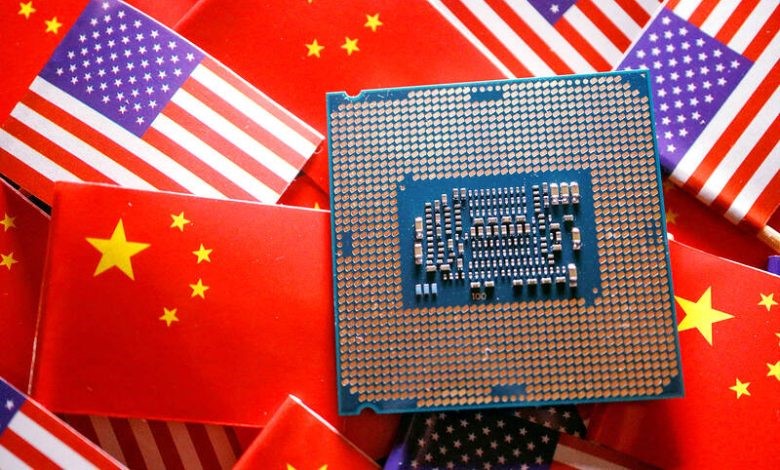
At the 2020 Munich Security Conference, the U.S. tried to persuade Europe to cancel its 5G contracts with China, but American companies still seek to participate in China’s 5G market and oppose U.S. restrictions. These restrictions have undermined trust between countries and companies, and U.S. allies find it difficult to ignore the significant cost differences between Chinese and American products.
This study was conducted at Diplohouse by Hamidreza Gholamzadeh in 2021.
To read more, click here