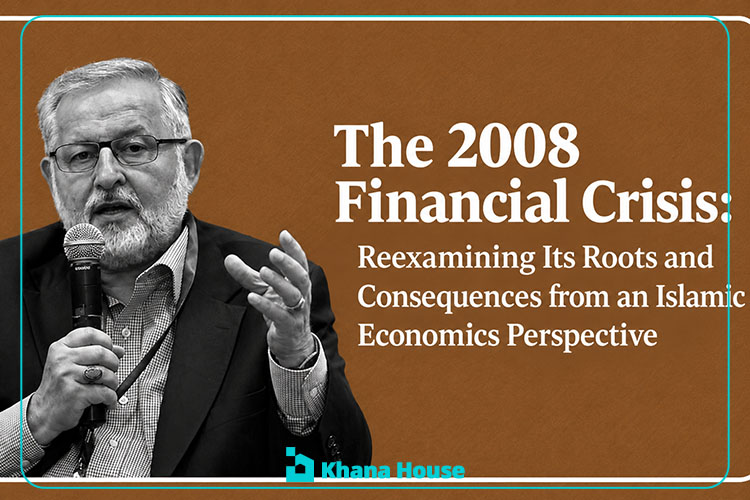
Borhan Leadership Institute presents an analysis by Abbas Mirakhor of the 2008 Financial Crisis and its consequences. His book examines the crisis’s structural causes and proposes Islamic economics as a more resilient and sustainable alternative to conventional finance.
Examining the Roots of the 2008 Financial Crisis
A) Excessive Financial Leverage and Systemic Fragility
High levels of debt and financial leverage increased the vulnerability of financial institutions, creating significant systemic risks behind short-term gains.
B) Complex Financial Instruments and Their Role in the Crisis
Mortgage-backed securities (MBS) and collateralized debt obligations (CDOs) obscured risks, contributed to asset-price inflation, and intensified the U.S. housing bubble.
C) Speculative Behavior and Its Impact on Markets
Speculative investment shifted capital away from productive activities and real assets, contributing to price bubbles and ultimately deepening financial instability.
D) Weak Regulation and Policy Failure
Inadequate financial oversight and ineffective policymaking allowed systemic risks and high-risk financial practices to grow largely unchecked.
Consequences of the Crisis: A Comprehensive Analysis of Economic and Social Effects
A) Loss of Confidence in the Financial System
The crisis severely undermined public and investor confidence in financial institutions.
B) Rising Economic Inequality
The crisis intensified economic disparities and imposed significant social costs.
C) Global Consequences of the Crisis
The financial shock spread internationally, affecting economies, financial markets, and economic policymaking worldwide.
Islamic Economics: An Alternative to Prevent Future Crises
Mirakhor presents Islamic economics as a more stable model based on justice, transparency, risk-sharing, and stronger links between finance and the real economy.
A) Profit and Loss Sharing
Risk and returns are shared more equitably among participants.
B) Prohibition of Interest (Riba)
The prohibition of interest seeks to limit debt-driven financial structures and excessive leverage.
C) Transparency in Transactions
Greater transparency can strengthen accountability and reduce financial uncertainty.
Proposed Strategies for Reforming the Financial System
- Strengthening financial market oversight: Regulators should closely monitor high-risk financial practices.
- Developing risk-sharing financial systems: Financial models should distribute risks more fairly among participants.
- Expanding Islamic financial instruments: Instruments such as sukuk and partnership-based contracts can provide alternatives to fragile conventional financial structures.
You can read more here